
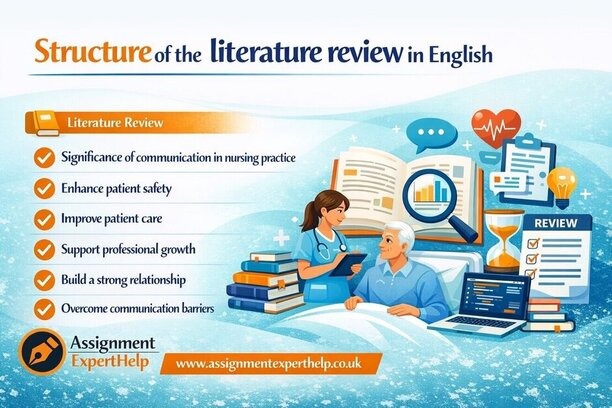
A literature review is nothing but a structured review, like an academic essay. The goals of a literature assessment are to review peer literature by understanding a selected issue, identify any knowledge gaps, and suggest areas for further studies. A literature evaluation must incorporate a summary of relevant information from numerous sources, including books, dissertations, journal articles that have been posted, conference complaints, and other educational sources. This blog submission will cover the many processes for composing a literature evaluation, while it’s more appropriate to achieve this for the duration of the study process, how a literature review is put together and the vital processes that need to be followed. Moreover, you can get an english assignment help service and get guidance to craft your polished literature overview with expert supervision. If you follow these recommendations and guidelines and get expert help, you will be nicely on your way to developing an efficient and thorough literature overview for your upcoming academic journey. Let’s get started.
Literature review
A clear and logical shape is important in your literature review. It should contain three main parts: an introduction that defines the background scope, a body that synthesizes the literature with methodology, and a conclusion that summarizes the key findings and also suggests the future research. It should be structured like other essays with its three main stages. Let’s discuss each of these in more detail.
Introduction
This must be the first section of your literature review that should provide an accurate and appropriate background context of reviewing the literature, and define the topic. In your introduction section, you must set the context, explain the scope behind your review, and outline the organisational structure. Your introduction should be a hook for your literature review in English. It should be interesting as the readers first take a look at this and then decide to go further. Put differently, the reader should be given a preview of what is ahead and an outline of how it will be presented in your introduction.
Main body
After demonstrating your topic and its context, the next section is the main body. This stage should organise the literature as a common theme by offering readers valuable insights into the topic that you have chosen. The core of your study is contained in the body of your literature review. This is the section where you will summarise, assess, analyse, and present the previous research. In this section, you have to critically assess and synthesize your literature review, use topic sentences, and connect your data with paragraphs logically rather than just summarizing it. Here you can also state the research design that you have used to gather the relevant information, such as surveys, questionnaires, and focus groups.
Conclusion
This has to be your last section, in this you will be summarising the key findings and present it clearly and concisely. You should summarise the main conclusions of your literature review in the conclusion section. Make sure to avoid adding any new information here. This section helps to give a summary of your whole study, along with future research, and highlights gaps.
Wrapping it up
In conclusion, structuring a literature review is a crucial component of any scholarly research. It gives a summary of what is currently known about a positive problem, stating regions of uncertainty and areas that would need more studies. A literature review must be organised with an introduction, a body, and a conclusion. You can seek help from assignment help service in writing a well-structured literature review in English.